
Three La Crosse County Property Values Are Not the Same
Assessed value is the municipal figure used for property taxes. Market value estimates what a parcel might sell for under stated conditions. A third number, the transfer price, appears when a deed is recorded. It comes through Wisconsin's Real Estate Transfer Return process. None of the three match automatically. The assessment roll lives with the local assessor. The sale price sits in deed and transfer records. An appraisal remains a separate professional opinion. Match the number to its source.
| Value label | Meaning | Where to verify |
|---|---|---|
| Assessed value | Municipal assessment figure for the parcel | Local assessor's record and assessment year |
| Market value | Estimated exchange value, not a tax bill amount | Sales evidence or a qualified appraisal |
| Sale price | Consideration associated with a recorded transfer | Transfer record and deed context |
| Equalized value | State value used to compare municipalities | Wisconsin DOR reports |
A comparison holds up only when you pin down the parcel, municipality, assessment year, and sale date at the outset. Skip that step, and the number may describe another lot or era.
Look Up a La Crosse County Assessed Value
Start in the county GIS map and find the parcel and its municipality. La Crosse County keeps no single assessor roll. So the assessor serving each jurisdiction is your next stop. The county Parcels app supports searches by Address, Owner, Tax ID and Parcel ID. A City of La Crosse parcel can be researched through the City Assessor page. That page offers a limited free assessment search and an expanded paid option. Elsewhere, a municipality may use its own office or contractor.
Copy the full parcel identifier exactly. The county uses a fixed-width format, 00-00000-000. Its own example expands 8-245-1 to 08-00245-001. Keep that ID with the assessment year. Land, improvement and total values belong alongside it. A parcel may be split or combined. Verify the value still matches the parcel configuration on the same land. A new number can appear on the map during the year. But tax treatment remains on the whole until the next year.
The City of La Crosse Assessor publishes assessment and sales resources on its official assessor page. That office's authority stops at the city boundary.
Assessment Ratios and Municipal Levels in Wisconsin
An individual assessment ratio, as Wisconsin's Department of Revenue defines it, is a parcel's assessed value divided by its fair market value. The assessment level is different. It compares a municipality's total assessed value with its equalized value. One ratio describes a parcel. The other summarizes a whole municipality. A municipal average near 100 percent does not show that any particular house or commercial parcel sits at that ratio. DOR publishes annual statistical reports listing aggregate ratios for each municipality. Cite the report year and municipality with any figure. Then examine the parcel's own assessment record, local sales data, and any explanation the assessor supplies. A countywide average never replaces parcel-specific analysis. A ratio is not an appraisal or expected sale price.
- Assessment ratio
- Individual parcel assessed value divided by its fair market value.
- Assessment level
- Municipal relationship between total assessed value and equalized value.
- Equalized value
- Statewide comparison measure used alongside local assessed totals.
- Assessment year
- The year attached to the recorded value being reviewed.
Land, Improvements and Total Value Need a Year
Municipal records often break value into land, improvements and a total. Keep each label as the assessor wrote it. The total can feed the tax calculation. It is not an offer to buy the property or an appraisal for a sale. After construction, a split, or a revaluation, compare figures from the same assessment year. Check whether the parcel description changed too.
The City of La Crosse posts annual residential and commercial sales PDFs and assessment-objection information that helps owners read the local assessment context. They do not prove one sale matches another parcel. Location, date, lot configuration and improvements all matter. For a value question outside the city, find the local assessor rather than applying the city's sales documents countywide.
Some decisions need more than a record. Lending, purchase or estate questions call for a qualified appraiser or professional. A public value record is an administrative data point with a stated purpose. It is not a private valuation engagement.
Where a La Crosse County Sale Price Appears
Wisconsin requires a Real Estate Transfer Return for most conveyances. The Register of Deeds links to the Department of Revenue's eRETR transfer-search directions. Start with those current DOR instructions. The live transfer screen shows sale information, but its fields and format vary. So do not assume every property displays an unrestricted sale-price field. Use the deed index next. It confirms the parties, the recorded instrument, and the legal description together.
The Register of Deeds keeps deeds and other recorded instruments at 400 N. 4th St., La Crosse. Its public Land Records Portal replaced the former LandNav route. For a document copy through Paygov, you need the volume and page or the document number. You also need an approximate recording year. Keep two questions separate. A transfer price is one thing; a deed's legal effect is another. Read each record in its own context.
Sale prices do not always surface in the public search. Ask the DOR or the county office what transfer information is available. Online displays may omit some sale terms.
Why the Assessment and Sale Figure Can Diverge
A sale and an assessment can describe different dates, land configurations, or purposes. The assessor's record may lag behind a recent transfer. Parcel splits sometimes get new numbers before separate taxation begins the next year. An old assessed amount compared to a later price means little without the years and parcel configuration in view. A transfer can also carry terms that make it a poor market comparison.
Work from the same parcel. Confirm the municipality, then write down the assessment year and the transaction date. Compare land and improvement amounts as separate pieces of evidence. Weigh the sale documents and municipal ratio reports the same way. The Wisconsin property-owner guide explains assessment and equalization concepts in plain terms. A licensed appraiser can determine market value for a specific purpose. County and municipal public records supply source material rather than replacing that work.
Sometimes the assessment record and the deed cite different parcel IDs. A split or combination is usually the reason. Follow the recorded legal description or CSM to establish which land each number covers.
Exemptions Affect Taxable Treatment, Not Every Value
Exemption questions run through the municipality and its assessor. The City of La Crosse publishes exemption forms with its assessment materials. Those forms fit that city, so do not assume they apply in another jurisdiction. Wisconsin's 2024 change made most formerly taxed personal property exempt. That shift touches the personal-property side of the tax roll. It does not touch the real-estate parcel workflow. It is also not an across-the-board real-property value reduction.
When comparing assessed and taxable amounts, identify the exemption, the parcel type, the municipality, and the assessment year. A tax bill's taxable treatment can differ from the assessment figure. That difference does not change what the property would sell for. Ask the assessor to explain a specific field or form. Follow the municipality's instructions. No countywide exemption inventory or single universal deadline exists. Check locally instead of assuming a schedule.
For bill totals, collection points, and the appeal process, use the property-tax guide. This value page stops at the meaning and source of the valuation numbers.
City Sales Records Add Local Value Context
The City of La Crosse Assessor publishes annual residential and commercial sales PDFs. These sit alongside its assessment search and objection information. These documents give city-specific sales context. They are not a countywide price series. Confirm the parcel sits inside La Crosse city limits before using them. Compare the sale date, legal description, and assessment year. A sale is useful evidence. It does not establish the present market value of another parcel.
The assessor's page offers the local route. It includes a limited free assessment search plus an expanded paid search. It also links exemption forms and the objection procedure. For a parcel outside the city, contact the municipality that serves it. The county Register of Deeds and the DOR transfer route remain the sources for recorded conveyances.
Visit the City of La Crosse Assessor for its sales documents and assessment links.
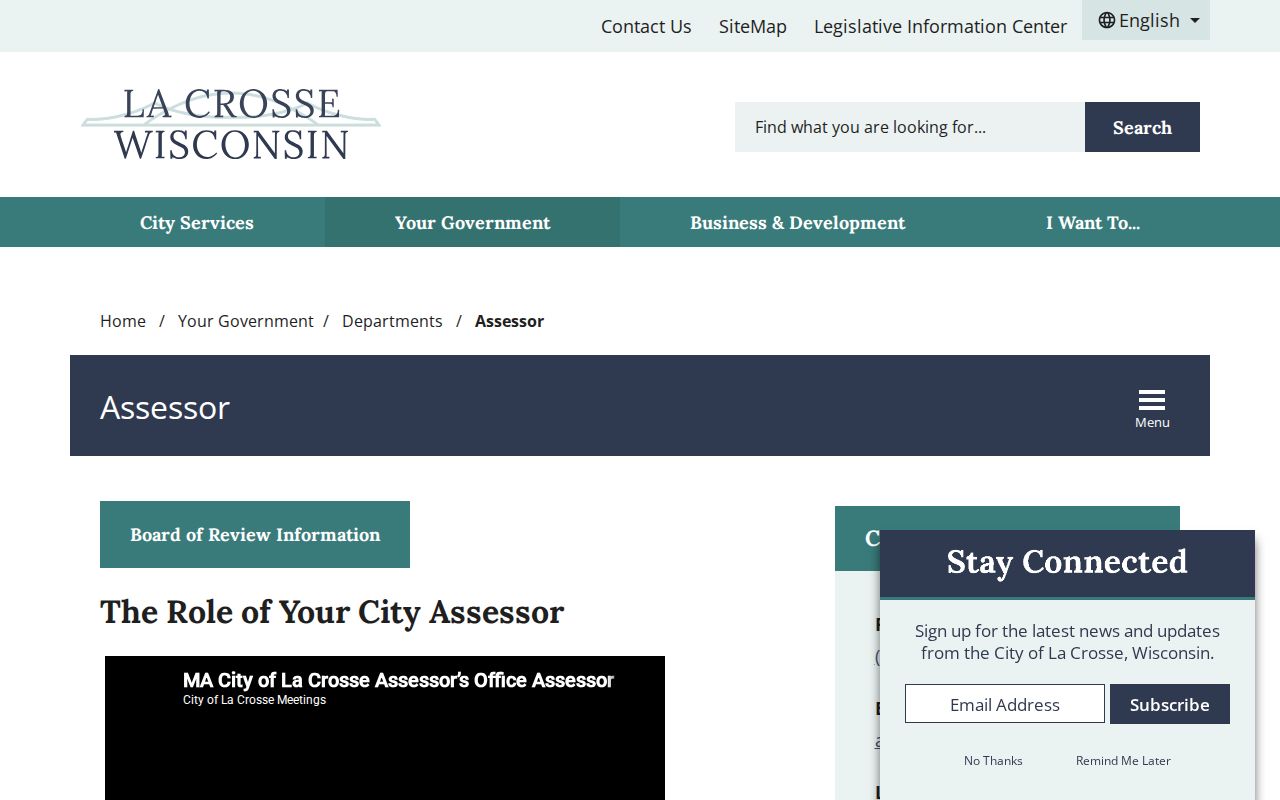
This city example helps interpret a value record without implying that one municipal series covers the whole county.
What an Assessed La Crosse County Value Cannot Prove
An assessed value is not necessarily what the property will sell for. It is not a professional appraisal. A municipal ratio report is not a parcel-specific value estimate. A tax bill is not a sale record. A recorded price does not establish present market value. Each record comes from a different source, date, and purpose.
Use the value for its stated purpose. The assessment is part of the tax system; obtain an appraisal for a valuation decision and confirm figures with the responsible assessor.
The City of La Crosse Assessor's annual sales PDFs cover one municipality. The county's GIS and Register of Deeds cover countywide parcel and instrument context. Match municipality, parcel ID, legal description, and year first. If a value will guide a purchase, financing, or legal decision, verify the source. Consult the appropriate professional.