
How to Find Who Owns a La Crosse County Property
The dependable public-record route is a sequence of steps. Use the county Parcels app or the public Land Records Portal first. Match the street address to a parcel. Confirm the municipality next. The assessor is local rather than countywide. Then pull that municipal assessment record for the owner of record. Search the Register of Deeds for the newest relevant deed. Compare its grantee, recording information, and legal description with the parcel. GIS rounds out the process by confirming location and parcel context. Starting from an owner name instead? The Parcels app offers an Owner search. But verify the parcel separately.
Each source plays a defined role. The assessor's roll gives a current administrative owner and value. The Register of Deeds records conveyances. GIS maps the parcel, and the Treasurer's bill shows taxes and taxing jurisdictions. No single record answers every part of ownership. A deed confirms a filed instrument. Yet it is not a complete title opinion. The county publishes no fully verified online deed index. So call the Register of Deeds when an important instrument does not surface online.
- Find the parcel from the full address or a known owner name.
- Copy its zero-padded parcel ID and municipality.
- Check that municipality's assessment record for the owner-of-record name.
- Search the latest recorded deed and compare the legal description.
- Ask the custodian to confirm gaps or ambiguous names.
Where La Crosse County Ownership Is Recorded
There is no single countywide owner database. Instead, several records each carry a piece of ownership. The shared county parcel framework locates the parcel. A city, village, or town assessor maintains or contracts the assessment work. The County Register of Deeds holds the recorded conveyance. The County Treasurer and municipal collectors handle tax questions. So a current owner inquiry should name the specific field or document wanted. That could be the assessment owner, the last grantee on a deed, or the recipient of tax mail.
| Source | What it gives | How to judge currency |
|---|---|---|
| Municipal assessment | Owner-of-record and assessment context | Check the assessment year and ask the local assessor |
| Register of Deeds | Recorded conveyance and land description | Locate the newest applicable instrument |
| County GIS / Parcels | Parcel ID, address and mapped location | Confirm municipality and current parcel configuration |
| Tax bill | Tax charges and mailing context | Match tax year and installment |
The online public portal replaced the legacy LandNav route. Its full search-field inventory remains unverified. Treat a blank search result carefully, then, because it does not prove that no deed or owner record exists.
Why the Assessment Name May Differ from the Deed
An assessment roll is an administrative record. It may not update at the same moment as a recorded transfer. The county points to a January 1 assessment timing issue and a split-year tax wrinkle: a new parcel number can be assigned midyear while the bill stays whole to the owner at the time of the split, with separate taxation beginning the next year. Date any name on a bill or assessment, then compare it with the deed's recording date.
Mailing and situs details can differ too. A tax notice goes to a correspondence address, while the situs identifies the land itself. The owner may receive mail elsewhere, or a company or trust may fill the owner field. Preserve those labels exactly. Never assume a mailing address is the property's location, or that a mailing recipient holds title.
When the roll and the deed seem to conflict, first confirm both records describe the same parcel and legal description. Then compare the deed's recording date with the assessment year, and ask the municipal assessor about the roll's timing.
Confirm an Owner Name Against the Recorded Instrument
After finding the assessor owner, search the Register of Deeds for a matching grantee name. Identify the most recent deed tied to the parcel. Read the legal description and municipality, not just the names. The name may be a trust, estate, or business entity. In that case, the recorded instrument may show the relationship or representative capacity. Search the entity's full name and the individual's role together. Do this only when the record supports that connection.
County deed copies can be ordered online through Paygov. You will need the volume and page or document number, plus the approximate recording year. Note: the online copy process is separate from the search index. For help locating a reference, call 608-785-9644 or 608-785-9645. A copy costs $2 for the first page. Each added page is $1, plus about $1 in Paygov fees. Certified copies are mailed within one business day. Expedited service is available for an extra charge. Verify the current process before ordering.
Not proof of clear title. An assessor name is an owner-of-record clue. A deed is a recorded instrument. Neither alone is a title search or a guarantee that no other interest exists.
When ownership affects a purchase or legal decision, have a qualified title professional review the chain rather than relying on a name field alone.
Entity, Trust and Estate Names Need Their Own Trail
Land in La Crosse County does not always sit under a person's everyday name. A deed may name a company, a trust, or an estate instead. The deed index often puts the entity on one side of the transaction. It then lists a trustee, personal representative, or other signer on the other. The assessor's owner of record field may shorten the same name. Before you tie any individual to a parcel, compare the full deed. Also compare the legal description. Keep the entity's exact spelling, suffix, and capacity as the instrument shows it. A familiar name alone does not prove that person owns the entity or the land. Wisconsin publishes no single business-entity workflow on this page. So treat any outside entity lookup as your own step.
Death-related transfers leave their own paper trail. The file may hold a transfer-on-death instrument or a survivorship deed. It may also hold a deed by a personal representative, a probate order, or an estate deed. Wisconsin Circuit Court Access shows the public circuit case where one exists. The property instrument itself stays with the Register of Deeds. A death certificate can confirm certain family facts for eligible requesters. But it never proves who received the land.
Use GIS to Confirm the Property, Not the Title
The county Parcels app searches by address, owner, Tax ID, or Parcel ID. Separate Zoning and PLSS apps layer on zoning detail and survey-system geography. Use the GIS map to check an assessment or deed reference. Confirm it points to the parcel you expect. Check the municipality field too. City, village, and town lines meet throughout La Crosse County. A postal label can mislead. La Crosse and Onalaska carry river, island, and town-edge geography. That makes jurisdiction hard to guess from an address alone.
Remember what the map is. A parcel shape helps with orientation. It is not a survey and not a title report. The county publishes no neighbor or buffer tools on it. A question may turn on the land actually conveyed. Then the recorded plat, the CSM, and the deed description remain essential. For a boundary or title conclusion, ask the right professional and custodian. Do not rely on a map polygon.
Protect Confidential Addresses and Use Owner Data Lawfully
Wisconsin Safe at Home gives eligible survivors a substitute address. A protected address is not an ordinary owner or address search result. The Department of Justice page explains the program. Never use a property record to locate, stalk, harass, or harm anyone. For lawful property diligence, take only the record detail you need. Confirm the land and its custodians.
The public tax roll has ordinary limits as well. The name can lag a transfer. It can reflect an entity. It may differ from the person who receives the mail. To contact an owner about a property matter, use a proper public mailing channel. Keep the reason tied to the land. An owner lookup should never become an effort to compile private facts beyond the property record.
For the wider method, the current owner record guide covers present-day assessment timing. The recorder confirms instruments. Treat any record result as a lead. Verify it with its custodian.
A City Assessor Search Is One Local Example
Inside the City of La Crosse, the City Assessor runs a limited free assessment search plus a paid expanded option. The same page links annual residential and commercial sales PDFs, objection information, and exemption forms. This is one local owner-of-record route, not a countywide assessor portal. Assessment in La Crosse County happens at the municipal level. A parcel in Onalaska, Holmen, or a town belongs to that jurisdiction's assessor or contractor.
Confirm the municipality and parcel ID in county GIS before trusting any name. An assessment owner can lag a recently recorded deed. The City's assessment page does not establish complete title on its own. For a transfer, set the roll beside the latest relevant instrument in the County Register of Deeds. The city office sits at 400 La Crosse St., third floor, La Crosse, WI 54601, with phone 608-789-7525. Hours run Monday through Thursday, 8 a.m. to 4 p.m., and Friday, 8 a.m. to noon.
See the City of La Crosse Assessor's official search and sales page for city parcels.
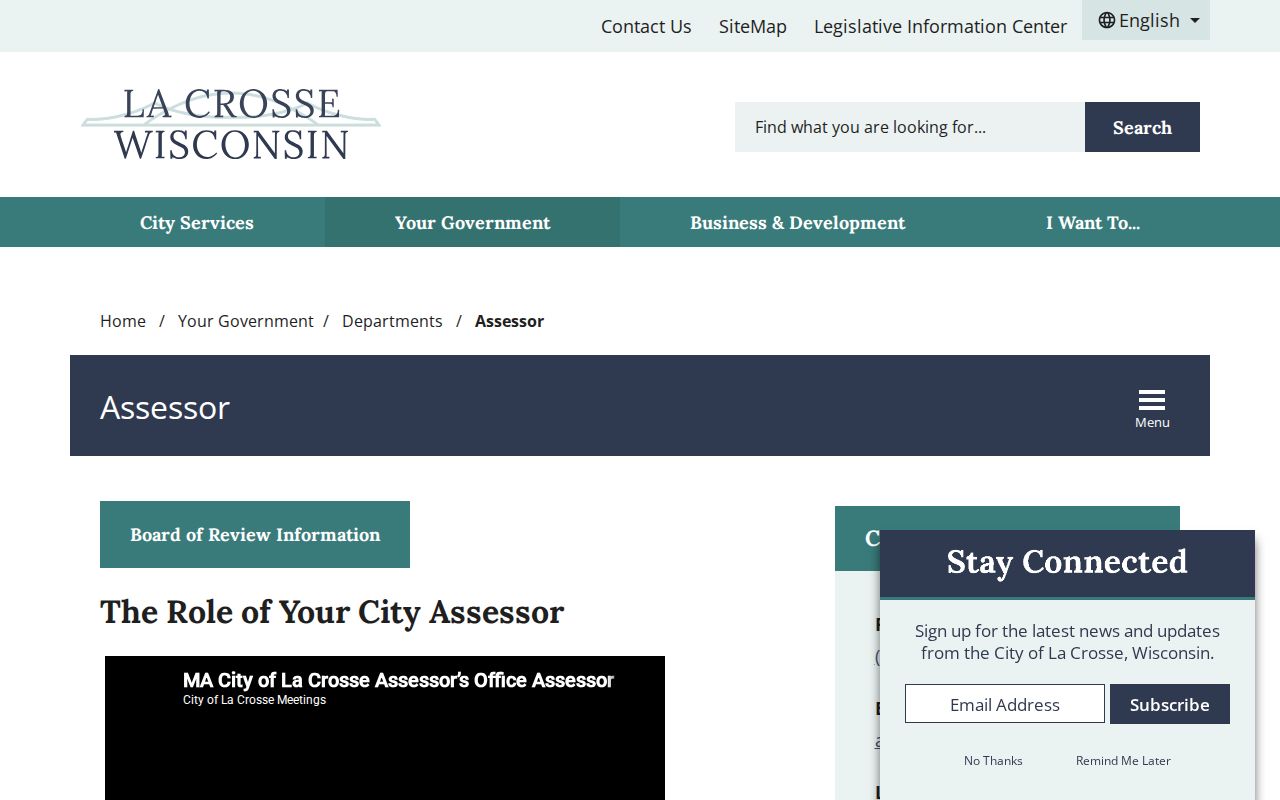
This local example helps you locate a city assessment record, while the Register of Deeds confirms the recorded conveyances.