
What a La Crosse County Tax Record Separates
A bill and an assessment record answer different questions. The assessor sets the value that drives the tax process in La Crosse County. The bill then shows what is owed, by which jurisdictions, and where payment goes. Expect the county, the school district, Western Technical College, the municipality, and special-purpose districts to appear on the lines. One total can therefore fold several taxing authorities together. Read each line and year closely before comparing parcels. Assessment stays local here. Cities, villages, and towns run their own assessment functions or contract them out, while County Land Information maintains the shared parcel and address data. The municipality field matters. It points you to the local assessor who actually holds the record. A City of La Crosse assessment search will not cover a parcel in Onalaska, Holmen, or a town.
| Record item | Question answered | Where to follow up |
|---|---|---|
| Assessed value | What value is recorded for assessment | The municipality's assessor |
| Taxing-jurisdiction lines | Which local bodies appear on the bill | The bill and local treasurer |
| First installment | Where the initial payment is collected | Often the municipality |
| Later tax questions | County-level payment or tax administration | County Treasurer, 608-785-9711 |
Find the Local Assessment Before Reading the Bill
Pin down the parcel and its municipality first, using county GIS or the Parcels app. The app supports searches by Tax ID, Parcel ID, Owner, and Address. Take that parcel ID plus the municipality name to the local assessor. Ask there for the actual assessment record. Remember that the county GIS hub is a parcel and zoning resource. It is not a countywide assessment office. City of La Crosse parcels go to the City Assessor. That office offers a limited free assessment search and a paid expanded one. The city's Assessor page also links its objection procedure. It posts annual residential and commercial sales PDFs and exemption forms too. The office sits at 400 La Crosse St., third floor, La Crosse, WI 54601, telephone 608-789-7525. Hours run Monday through Thursday, 8 a.m. to 4 p.m., plus Friday, 8 a.m. to noon. Those details apply only to the city office. Other municipalities keep their own. Before trusting a value on a bill, match the owner, situs address, parcel number, and assessment year. The City of La Crosse Assessor page gathers that material in one place. It holds the municipal assessment search, sales data, and objection material.
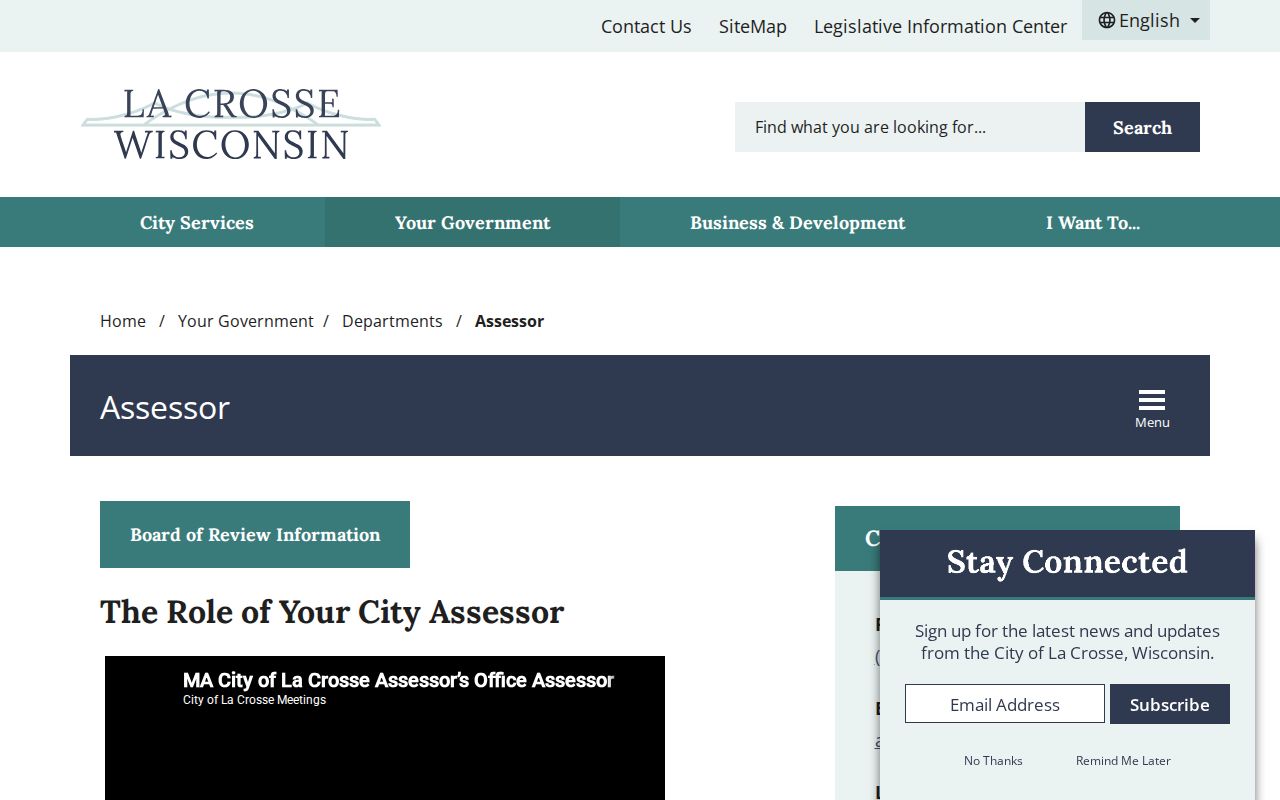
The lesson is simple: the city office serves only parcels inside its own jurisdiction.
Land, Improvements and the Meaning of Total Value
An assessment record usually splits land from improvements before giving a total. Those totals are assessment figures, not a sale price or an appraisal. The county's tax interpretation guide walks through bill fields and ratios. The municipal assessor handles parcel-specific questions. Always keep the assessment year beside the value. A bare number misleads when you compare bills, recent sales, or a revised parcel. A fresh transfer does not make the assessed amount equal the price paid. Wisconsin's Department of Revenue defines an individual parcel's assessment ratio. It is assessed value divided by fair market value. The assessment level, by contrast, describes a municipality's total assessed value. It shows how that total relates to the municipality's equalized value. The two measures are not interchangeable. A municipal average near 100 percent proves little by itself. It cannot show that any single parcel sits at that same ratio.
- Assessed value
- The municipal assessment amount used in the property-tax process.
- Assessment ratio
- For an individual parcel, assessed value divided by fair market value.
- Assessment level
- The municipal relationship between total assessed value and equalized value.
- Tax bill
- The annual charge record across the listed taxing jurisdictions.
Compare like with like. Use the same parcel, the same assessment year, the same land, improvements, and total split, and the same taxing jurisdiction.
Municipal Aggregate Ratios Need Careful Reading
The Wisconsin Department of Revenue publishes annual assessment statistics, including aggregate ratios for each municipality. Those reports sketch the broad assessment context across La Crosse County. They are not estimates for one parcel. A municipality-wide assessment level is a summary, and each parcel's own ratio is calculated separately. A tight county or municipal average cannot prove that. Two neighbors may not be assessed equally against market value. Treat the aggregate ratio as background. Then read the assessor's record for the parcel. Then read the local sales data for the area. The City of La Crosse posts annual residential and commercial sales PDFs. Those lists help reveal sale patterns. Yet any single transaction may differ in condition, location, or timing. A ratio report never replaces an appraisal. A sales list never replaces the assessor's own explanation of the parcel record. The DOR assessment statistics page and Wisconsin property-owner guides explain the ratio-versus-level distinction. When citing a ratio, keep the report year and municipality name attached. These figures are annual and local, and losing either detail strips the number of meaning.
Parcel Splits Can Delay a Separate Tax Bill
La Crosse County gives a split parcel a new parcel number during the year of the split, yet the tax bill still goes to the owner as a whole. Separate taxation starts the next year. That gap trips people up. The parcel map and the current tax bill can sit at different points in the parcel's administrative timeline, and neither record is necessarily wrong.
A new lot may lack its own bill. Compare the split date, the recorded deed or CSM, the parcel history, and the tax year. Never read the map alone. It cannot show whether taxes are missing or paid.
The county Real Property Listing FAQ also covers parcel combinations for tax purposes. Combination does not erase the legal description. Ask the assessor or tax collector how the specific parcel is carried. Check the recorded instruments for its legal boundaries.
For a first installment, the municipality is usually the collector. Later questions go to the County Treasurer at 608-785-9711. The split year tells you which office to ask.
First Installment and Later Payments Have Different Contacts
Many La Crosse County municipalities collect the first installment. Subsequent tax questions go to the County Treasurer. That arrangement makes the parcel's municipality more than a map detail: it tells you where to begin when a bill or payment record does not match your expectations. The county records map directs the first-installment question to the municipal treasurer and lists 608-785-9711 for the County Treasurer.
Before calling, note the parcel ID, tax year, municipality and installment in question. A bill may include county, school, technical-college, municipal and special-purpose charges. Ask the collector to identify the line or payment status you mean. Do not assume a receipt for one installment resolves an assessment objection or another tax year. For value disputes, contact the assessor and follow the municipality's procedure; for payment status, contact the collector.
The county tax interpretation guide provides a field-by-field explanation. It is a better starting point than interpreting an aggregate total without the listed jurisdiction lines.
Exemptions and Assessment Questions Stay Local
Exemption questions start local. They belong with the office that administers the form. The City of La Crosse Assessor publishes exemption forms, an objection procedure, and assessment and sales resources. That does not travel. A form or deadline on the city page may not apply to a different municipality. Outside the city, first find which city, village, or town maintains the assessment. Ask that office for its documentation list.
Wisconsin's 2024 change made most property previously treated as personal property exempt. It stays a personal-property matter. It is not a blanket real-estate exemption or an automatic cut to a parcel's land and improvement values. For a real-property assessment, compare the parcel record, the exemption information, and the assessment year.
The county publishes no countywide exemption list. Each municipality handles its own paperwork. For statewide context, the Department of Revenue's property-owner publications explain assessments and equalization, but the local assessor remains the custodian of a parcel-specific answer.
Assessment Objections Require the Municipality's Process
The City of La Crosse posts an assessment-objection procedure and sales PDFs. They help a city owner compare recorded assessment information with local sales. They also show where an objection goes. No one calendar covers every La Crosse County municipality. Deadlines vary by municipality. Confirm the notice, filing window, and evidence requirements with the assessor before acting on a date.
Keep your paperwork together. Bring the parcel ID, assessment year, and description. A municipal aggregate ratio is context, not parcel-specific proof. A sales PDF alone does not prove two properties comparable. Ask which assessment details the assessor used, what comparable-sale source applies, and what local review step is available. Value questions fit the property-value guide; payment questions fit the relevant treasurer.
Check the local deadline. The City Assessor publishes an objection route, but dates and procedures must be confirmed with the municipality responsible for the parcel.
Your objection belongs with the local municipality that assessed the parcel, not with some other city's process. Talk to the assessor's office that keeps the tax roll for your property.
January and July Installments Have Separate Routes
January 31 and July 31 are the installment dates in the county tax interpretation guide. Check your own bill first. The year and payment choice determine where questions go. Municipalities often handle the first installment. Later questions go to the County Treasurer at 608-785-9711. Keep the parcel ID, municipality, tax year, and installment together when asking about payment status.
Wisconsin's 2024 Act 12 made most property previously treated as personal property exempt beginning January 1, 2024. It mainly touches personal property, not the normal real-estate parcel assessment workflow. It is not a blanket exemption from real-property taxes or a change to a property's market value. Ask the assessor which record and exemption category applies.
Assessment, Tax and Recorded Ownership Are Separate
A deed, an assessment, and a tax bill answer three different questions. The deed is the recorded proof that a conveyance happened. The assessment reflects a municipal opinion of value and lists the owner of record. The tax bill tracks the charge and the payments. None of them alone proves clear title. The assessment roll can lag behind a recent transfer, and a tax record can carry through a split year. Need to confirm a recorded conveyance? Lean on the deed. When the question is tax administration, the assessor or treasurer is the right office.
Match the legal description and parcel number first to compare values across La Crosse County records. The county GIS map supplies the parcel and municipality context. The Register of Deeds holds the instruments. Each municipal assessor can explain an assessment. If figures disagree, check the year, the parcel configuration, the municipality, and the transfer timing before anything else. Still conflicting? Ask the relevant custodian to walk you through the source record. Do not blend the numbers into one value.